Categories
ALA Books Media presentation

ALA TechSource Trends Webinar

TechSource has posted the recording of the TechTrends Midwinter 2010 Webinar that I was a part of a couple of weeks ago, along with Sean Fitzpatrick, Kate Sheehan and Greg Landgraf. I’m really pleased with it…check it out, and let me know if there are any questions you’d like me to follow up on.

TechTrends: Midwinter 2010 Webinar Archive from ALA Publishing on Vimeo.

TechTrends: Mid-Winter 2010, an archive of the 2/11/10 ALA TechSource webinar. The ALA Midwinter meeting was discussed from a library technology perspective. Our panel of experts offered their own unique perspective, sharing what they learned from the conference and what trends they thought stood out, plus, a question-and-answer session with the panelists.

Categories
Media Personal

Feeling bub.blicio.us

Check out my video that got featured on bub.blicio.us today…my co-conspirator for CES decided to use my video in her wrap-up post:

http://bub.blicio.us/a-belated-ces-wrap-up/

Rock on!

Categories
ACRL ALA presentation

Wave upon Wave

In a little more than a week, on March 2nd, I’ll be doing an online webinar for ACRL entitled Wave upon Wave: Navigating the New Communication. The goal is to explore and explain Google Wave, and look at use cases for libraries. Wave lost a lot of luster immediately after the launch, but I still think there’s a ton of promise and potential there. Here’s the learning outcomes that we’ll be trying to get to:

Participants in this webcast will come away with an understanding of the basic functionality of Google Wave. As well, they should be able to envision multiple communicative uses for Wave within their library, including both internal and external communications.

We’ll probably also talk a bit about Buzz, and the ways in which the various Google properties relate to one another. I hope to see you there!

Categories
Books Legal Issues Media

Shut up and get out of the way

Google, on the Book Settlement, from arstechnica:

“Approval of the settlement will open the virtual doors to the greatest library in history, without costing authors a dime they now receive or are likely to receive if the settlement is not approved,” Google’s filing reads. “Nor does anyone seriously dispute, though few objectors admit, that to deny the settlement will keep those library doors locked while inviting costly, fragmented litigation that could clog dockets around the country for years.”

Or, in other words: Shut up, and get out of the way.

Categories
Apple Gadgets Media

Is this new on the iPhone?

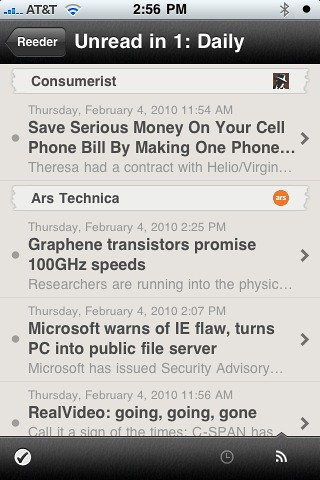
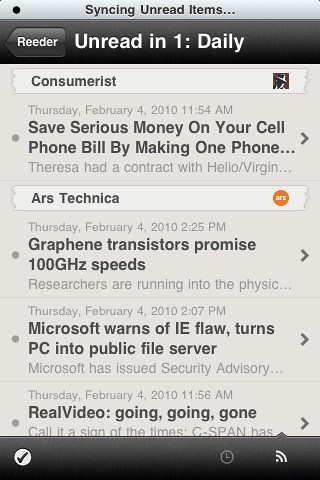
I’ve been testing a new Google Reader app over the last few days called Reeder, and noticed a UI piece that I hadn’t seen before on the iPhone. Check these pics:

Reeder Reeder

On the first one, check the small dot in the upper right. If you swipe it, it folds to the left and shows the text on the second pic. Swipe back, and it goes back to the standard connectivity/time message. This is the first time I’ve ever seen an app take over the title bar…some make it go away, but this is the first I’ve seen with this behavior.

Are there any others that do something similar? It says something about the tyranny of the Apple UI guidelines that this shocked me so much.

Categories
Books MPOW

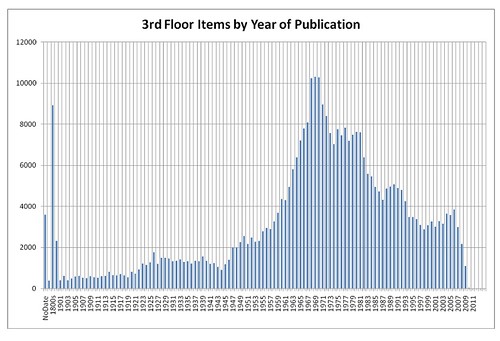
Collection distribution by publication date

At my place of work, we’re just beginning a massive weeding project as a part of the larger new library building project. We are hoping to weed the entire collection for, effectively, the first time in the history of the library. Needless to say, it’s kind of going to own our lives for the next 18 months.

As a part of this, my awesome co-worker Andrea created this chart showing the distribution of publication dates for our collection. The massive amount of 1800’s is from our Early English Books Online collection, but the rest of it shows a pretty great distribution of “when did the library have funding” over the decades.

collection by pub date

Categories
Media

2009 State of the Union Word Cloud – retrospectively

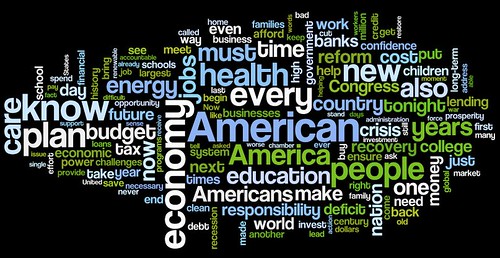
Since I realized that I had missed doing the 2009 State of the Union Word Cloud, here it is. Big difference from this year? “Economy”…barely mentioned this year, swapped for the more down-to-earth “Jobs”.

Wordle - State of the Union 2009

word cloud by wordle

Categories
Media Personal

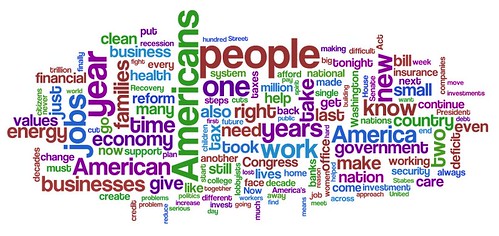
2010 State of the Union Tag Cloud

In the vein of my previous years, here’s a Tag Cloud of the 2010 State of the Union address delivered tonight by President Obama. It’s particularly interesting to compare to the 2007 and 2008 State of the Union addresses (I skipped 2009, for some reason…should probably do it retrospectively I went back and did the 2009, for comparison).

Wordle - State of the Union 2010
cloud created by wordle

Categories
Personal

Google Voice Mobile Browser edition

I didn’t actually expect my “Death of the App” trend to move this quickly, but seems like Google is determined to prove me right. 🙂 Google says “we don’t need an app” to Apple, and provides nearly exactly the same functionality via HTML5.

Categories
ALA Personal presentation

Top Tech Trends – ALA Midwinter 2010

I just realized that I had yet to post my Trends from Midwinter 2010. I will say that I was incredibly pleased with being on the panel with such a great set of librarians, and was overly nervous about the whole thing right up until we started talking. I know it’s silly, but Top Tech Trends is the event that I’ve been attending since my first ALA, and it immediately became a personal career goal to someday be a Trendster. The fact that I actually got to do it still hasn’t really sunk in, especially so early in my career.

I was planning on linking out to a ton of stuff, but this amazing page of links collects pretty much everything that anyone talked about…awesome job putting that together!

Without further ado: My trends, exactly as written before the panel started. I went off the tracks a bit once I started talking, needless to say.

The Year of the App
2009 was the year of the Apple iPhone/iPod Touch App Store….over 1 Billion Apps were downloaded in the first nine months of the App Store, the second billion only 5 months later, and only 3 months from that for Apple to announce 3 billion downloads. 2010 is the year that Apps show up everywhere…small, specialized programs that do one thing in a standalone way are going to be everywhere: every phone, printers, nearly every gadget is going to try and leverage an App Store of some type. Libraries have started down this road with the OCLC Worldcat iPhone App, the DCPL iPhone App, and more coming.

The Death of the App
2010 is also the year of the Death of the App. Many developers are using Apps because they allow functions that were non-existent in other ways. Many of the reasons to program stand-alone Apps disappear when the HTML5 and CSS3 standards become widespread. HTML5 allows for many things that were previously only available by using secondary programming languages or frameworks, like offline storage support, native video tags, svg support for natively scalable graphics, and much, much more. As an increasing number of web developers become familiar with the power of HTML5, we’ll see a burgeoning of amazing websites that rival the AJAX revolution of the last 2-3 years. No less a web powerhouse than Google has said that they won’t develop native apps in the future, and will instead concentrate on web development.

The Year of the eReader
This year will see the release of no less than a dozen different eReader devices, based around the eInk screen made popular by the Amazon Kindle. While Sony and Barnes and Noble launched new readers in 2009, the choices available in 2010 are going to be dizzying. How libraries handle this shift to electronic texts remains to be seen. New and exciting eBook technologies like Blio and Copia are going to revolutionize electronic texts.

The Death of the eReader
Early 2010 is going to be the height of the eReader, and late 2010 will see their decline, as the long-awaited Tablet computing form factor is perfected. The heavy hitters of computing are all producing a form of Tablet system this year, and with a wide variety of customized User Interfaces. With the rise of the Tablet form factor, we’ll see a slow decline of the stand-alone electronic reader, especially as display technology and battery life extend the usability of the Tablets.