
Here’s the first picture of the Griffey clan all together for the Holidays, grandchildren included.
Here’s hoping that your holiday is great.
Jason Griffey is the Executive Director of the Open Science Hardware Foundation. Prior to joining OSHF, he was the Director of Strategic Initiatives at NISO, where he worked to identify new areas of the information ecosystem where standards expertise was useful and needed. Prior to joining NISO in 2019, Jason ran his own technology consulting company for libraries, has been both an Affiliate at metaLAB and a Fellow and Affiliate at the Berkman Klein Center for Internet & Society at Harvard University, and was an academic librarian in roles ranging from reference and instruction to Head of Library IT and a tenured professor at the University of TN at Chattanooga.
Jason has written extensively on technology and libraries, including multiple books and a series of full-periodical issues on technology topics, most recently a chapter in Library 2035 - Imagining the Next Generation of Libraries by Rowman & Littlefield. His latest full-length work Standards - Essential Knowledge, co-authored with Jeffery Pomerantz, was published by MIT Press in March 2025.
He has spoken internationally on topics such as artificial intelligence & machine learning, the future of technology and libraries, decentralization and the Blockchain, privacy, copyright, and intellectual property. A full list of his publications and presentations can be found on his CV.
He is one of eight winners of the Knight Foundation News Challenge for Libraries for the Measure the Future project (http://measurethefuture.net), an open hardware project designed to provide actionable use metrics for library spaces. He is also the creator and director of The LibraryBox Project (http://librarybox.us), an open source portable digital file distribution system.
Here’s the first picture of the Griffey clan all together for the Holidays, grandchildren included.
Here’s hoping that your holiday is great.
I just realized that I’d been busy over on Brand New World, but that I hadn’t actually posted a picture here on Pattern Recognition. For the whole story, check over there.
Welcome to the world, Eliza!
There aren’t likely to be many posts here at Pattern Recognition for the next little bit, as Betsy is laboring even as I type to give birth to our first child.
Follow along over at Brand New World, or the live stream at Twitter.
Besides being way too long since my last post (it is getting busy around here, and Eliza hasn’t even shown up), it’s about time for an update on the Library Building Project.
If you take a look at the wiki, we’ve basically filled it with information about all our existing square footage, projected square footage, and basic collection decisions. At the last building committee meeting, we received the go ahead from the committee to look at compact shelving for our entire collection. This was a huge concern, we weren’t sure that everyone would see the benefits…the numbers are there in the wiki, but it saves us nearly 20,000 sq ft that could be used for patron-centered services.
I’m particularly happy with the feedback form. People are starting to use it to tell us what they want out of the new space, and we’re marching ever toward a shiny new patron centered library.
I can’t believe that it’s already December.
That is all.
—————-
Now playing: The Ramones – Chinese Rock
Ok, so we’ve all seen the press, read the Newsweek story, and if you’re reading this you probably read my take on the Amazon Kindle. Here’s a new feature that wasn’t heavily marketed for the Kindle, that has a direct impact on library efforts…and the surprising thing is, it has nothing to do with reading a book.
I’m talking about Amazon NowNow.
It’s an “experimental” feature on the Kindle, but NowNow is a human-powered answer engine that uses the Amazon Mechanical Turk group to search and answer questions for users. The service is in beta, and has been for a year or so (Jessamyn blogged about NowNow back in January).
So what’s the big deal? Well, the Kindle is an always-on internet appliance…anywhere you can get a cell signal, you can be online with the thing. Which means that you can ask a question and get an answer, from nearly anywhere, from a human, emailed directly to the device you used to ask the question in the first place. And this is built into the device…yes, Amazon might decide to charge for this, but right now they aren’t.
Is this Reference 2.0? Imagine being asked a research question by a patron, finding the perfect article for them, and being able to send that article to the device they are going to use to read it. Yes, I realize that laptops sort of fill this goal already, but the Kindle is certainly a more user-centered way of getting at this process. The patron doesn’t have to find a way to ask us questions…the device they are using is a direct line to us. It might not be that distinct from a webpage with a meebo widget…but I think it is qualitatively different somehow.
How?
Discuss.
Got a beta invite to Hulu.com today, the new video sharing site backed by the actual media conglomerates…NBC, FOX, ABC. More thorough review as I play with it.
Surprisingly, there’s an embed function. This post is just to test it, see how long it lasts, and if eventually they time-phase these out.
Wow!
The Kindle is for sale at Amazon right now, and the details of the device are intriguing. More highlights:
And, my favorites:
Here’s the bad:
Ah, and here’s where eBooks and physical books diverge, and is the source of 99% of my frustration with the format (also from the License Agreement):
Use of Digital Content. Upon your payment of the applicable fees set by Amazon, Amazon grants you the non-exclusive right to keep a permanent copy of the applicable Digital Content and to view, use, and display such Digital Content an unlimited number of times, solely on the Device or as authorized by Amazon as part of the Service and solely for your personal, non-commercial use. Digital Content will be deemed licensed to you by Amazon under this Agreement unless otherwise expressly provided by Amazon.
Restrictions. You may not sell, rent, lease, distribute, broadcast, sublicense or otherwise assign any rights to the Digital Content or any portion of it to any third party, and you may not remove any proprietary notices or labels on the Digital Content. In addition, you may not, and you will not encourage, assist or authorize any other person to, bypass, modify, defeat or circumvent security features that protect the Digital Content.
That book you bought? Not yours. Can’t sell it. Can’t even give it away.
Oh, and for those librarians who still hold tight to the privacy bandwagon:
Information Received. The Device Software will provide Amazon with data about your Device and its interaction with the Service (such as available memory, up-time, log files and signal strength) and information related to the content on your Device and your use of it (such as automatic bookmarking of the last page read and content deletions from the Device). Annotations, bookmarks, notes, highlights, or similar markings you make in your Device are backed up through the Service. Information we receive is subject to the Amazon.com Privacy Notice.
They know when you are reading. They know what you are reading, and that you bookmarked the sex scenes. Oh yes, they know.
So, exciting new product? Yep. Amazon, like Apple before them, has realized the power of a closed market segment, where they control the distribution and the consumption of media. The real test will be whether this survives the 2-3 year adoption cycle and moves into the magic price point range ($100-150).
“The vision is that you should be able to get any book”not just any book in print, but any book that’s ever been in print”on this device in less than a minute.” –Jeff Bezos
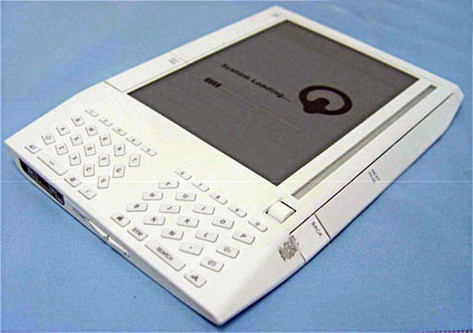 How’s that for a librarian’s dream? The Kindle, Amazon.com’s new eReader, launches tomorrow, and Newsweek has an article online about the new, possibly revolutionary, product.
I can’t do a complete thinkpiece on the Kindle right now, but over the course of the week I’ll get to my take on the device. There are still lots of questions unanswered (the wireless connectivity charge, for one), but here’s the quick take to be expanded on later:
—————-
Now playing: Counting Crows – Love and Addiction
Just some quick thoughts about my recent posts, as responses to comments.
Todd said:
Virtual meetings are all very nice, but its never the same as meeting people in person. In addition, real-life conferences give you a chance to see places you might not have gone otherwise…virtual conferences mean you stay right where you are.
I completely agree. My suggestion to virtualize aspects of the conference experience are not intended to downplay the value of face-to-face meetings. It’s just that we need to recognize that F2F isn’t necessary for communication to happen…it brings bonuses, but for the purposes of conducting business (like, for instance, the ALA Midwinter meeting), virtual is the appropriate realm.
Tom Hogan said:
Jason, thanks for attending Internet Librarian in Monterey, and I hope you found it worthwhile. As I mentioned in my little welcome speech, we had a record turnout this year, which is due primarily to the variety and excellence of the presentations from people dedicated to the information profession.
I’m sure that online conferences have their place, but I have to agree with Todd that people still want to meet in person from time to time. As long as that holds true, Information Today will continue to organize them. Regards.
Hi Tom! I was one of your “people dedicated to the information profession” that presented at IL this year. I was one of the faculty for what I believe was the largest preconference at IL.
Again, I’m not saying that virtual is done at the expense of F2F. Ideally it should be done in conjunction with…the very fact that we are talking as if there is a dichotomy between the two is ludicrous.
The truth is that the best librarians I know are both virtual and physical, all the time. They are connected, and consider their prioperceptive virtual self without effort. They are the librarians that you saw at IL who were sitting next to each other, blogging the session, updating Twitter, and IM’ing the person next to them with comments about the session. To pretend that being at IL “in real life” precludes a virtual component is to miss the forest for the trees.
My point is that we also should be reversing this equation: we should be making the virtual a significant and integral part of the ongoing F2F conference experience. The fact that at a conference called Internet Librarian we still have physical pieces of paper for people to sign up for dinners around town is, to put it mildly, amusing.
