Categories
Legal Issues Library Issues

Even more Gormangate followup

And the Gormangate news continues. LISNews put up a summary of the blog coverage, and Library Journal published a reaction piece on the coverage of the story by bloggers, which Karen Schnieder proceeded to take apart with near surgical precision. I don’t really have much to add to her pitch perfect analysis, with the exception of this quote from LJ:

Gorman, whose views do not represent the official positions of either ALA or California State University Fresno (where he directs the library), has received more than 100 messages—more than half of them sent pseudonymously.

Karen does a great job analyzing the first part of this, but I’m a bit interested in the last bit. Why take the time to point out that some of the messages were sent anonymously? The only reason to do so that I can imagine is an attempt to lessen their impact. If the people can’t even put their name on a letter, why should we take them seriously, right? I can’t see any other reason for LJ to point this out, and that’s what bothers me most.

In this country (the US, for those keeping track) we have a longstanding tradition, upheld by the highest court in the land, of anonymous criticism. The courts have long held that for speech to be truly free, one aspect of that is the freedom to be anonymous in your speech. In the central case for this right, McIntyre v. Ohio Election Commission, Justice John Paul Stevens wrote:

Under our Constitution, anonymous pamphleteering is not a pernicious, fraudulent practice, but an honorable tradition of advocacy and of dissent. Anonymity is a shield from the tyranny of the majority.

In an even earlier case, Talley v California, Justice Hugo Black, noted:

Even the Federalist Papers, written in favor of the adoption of our Constitution, were published under fictitious names. It is plain that anonymity has sometimes been assumed for the most constructive purposes.

In addition to the various poor journalistic practices pointed out by Karen, to be dismissive of anonymous criticism is to be ignorant of the history of speech in this country. I would expect better of Library Journal.

EDIT: The Shifted Librarian has a humorous look at possible new topics for Gorman to examine.
Categories
Legal Issues Library Issues

Help reform copyright law

The US Copyright office is looking for stories about Orphaned works (works where you wish to use them, but the copyright status is either impossible to determine or so complicated as to be enormously costly to determine). As the website Orphanworks.com describes it:

For designers, academics, artists, musicians, and filmmakers, using copyrighted works can be a huge headache. It can be impossible to find out if a particular work is still under copyright or not. And even when people would happily pay to use a copyrighted photo, passage, or video clip, it’s often impossible (or extremely costly) to find the copyright holder. When this happens, everybody loses. Artists can’t realize their creative vision, academics can’t clearly communicate their ideas, and copyright holders don’t get paid. Even worse, important pieces of our culture get needlessly locked away.

The Orphanworks.com site is being ran by the EFF, FreeCulture.org and Public Knowledge, and is basically a clearinghouse form that sends comments directly to the US Copyright office. This is an important request, and the more comments that are sent in the better chance we have of reforming copyright law into something resembling its original purpose:

The Congress shall have Power … To promote the Progress of Science and useful Arts, by securing for limited Times to Authors and Inventors the exclusive Right to their respective Writings and Discoveries

(United States Constitution, Article I, Section 8)

But hurry! The deadline for comments is March 25th!

Categories
Digital Culture

There Can Be Only One

A man was beheaded in a frenzied and prolonged axe attack in a London street today.

The axeman, smartly-dressed and in his thirties, felled his victim with one blow and then struck repeatedly “as if he was chopping wood”.

When asked why he had done it, he told officers: “It’s complicated. It’s private.”

Officers didn’t report on the bizarre electrical storm that surely followed the beheading.

Categories
The Living Dead

The Zombie Scenario Survivor Test

Official Survivor
Congratulations! You scored 59!
Whether through ferocity or quickness, you made it out. You made the right choice most of the time, but you probably screwed up somewhere. Nobody’s perfect, at least your alive.
Link: The Zombie Scenario Survivor Test written by ci8db4uok on Ok Cupid
Categories
Digital Culture

Sewanee Cemetery


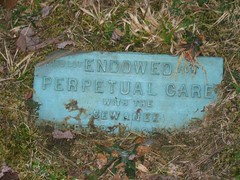
One of the wierder sections of Betsy’s contract with The University of the South is that as a tenure track professor she has a right to a plot in the University Cemetery. It’s a very old cemetery for this part of the country, with gravesites dating to before the Civil War. The photo is one of the plot markers that dot the ground among the graves.

Categories
Digital Culture

Kelsi at Aquarium


In going through my photos and choosing which to put up on Flickr, I came across a few that I had forgotten I took. This was my favorite of that bunch, a shot of Betsy’s neice Kelsi at the Chattanooga Aquarium.

Categories
Digital Culture

Bets in Chapel Hill


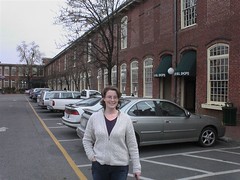
Via the power of the camera phone, email, Flicker, Travis, and the general coolness of teh Intarweb, I present: Betsy on vacation in Chapel Hill. Looks like she’s on the way to lunch at Elmo’s Diner. Meanwhile, I’m at home in TN with the new puppy and a bunch of horror films. Let the weekend commence!

Categories
Digital Culture

Hippiepunk

Take a look…an amazing snippet of a news piece from the CBC from 1967 about the Hippie movement in Yorkville. Why should you watch this? Because the hippie that is interviewed at the beginning of the piece, Bill, is now better known as William Gibson, one of the founders of the cyberpunk movement of sci-fi and the writer of the book after which this blog is named.

Really a great window into the world of 1967, but it is incredible to look at that 19 year old and see and hear in him the author that would come to be.

Categories
Books

Stranger in a Strange Land

Product Image: Stranger in a Strange Land
My rating: 4 out of 5

One of my all time favorite novels, recently re-read. Heinlein certainly had his problems…his portrayals of women especially should raise a few eyebrows, but the theme of the book is still a powerful one. One of the first pure sci-fi books I was able to convince Betsy to read, and it even won her over.

Categories
Digital Culture

Structured Blogging

There’s a new wordpress plugin called Structured Blogging that I’m checking out, and that might be interesting to a few of you out there (esp. the librarians). The basic concept is explained on the site Structured Blogging…here’s an excerpt:

Using structured blogging means it’s easy to create, edit, and maintain these different kinds of posts. In fact, for most purposes, structured blogging won’t really seem like a big deal at all – it’s just another edit form on your blog. The difference is that the structure will let you add specific styles to each type, add links and pictures for reviews, and so on.

Once structured blogging is in place, you can start building applications on top of it. Because it’s an XML format and embedded in both the HTML blog and the syndicated feed, applications can run in web browsers (like a firefox plugin for comparison shopping which reads product reviews); aggregators (like an aggregator that adds your friend’s calendar entries to your datebook); or web services (like a feed for everyone who’s attending the same conference as you).

So, effectively, it’s a way of wrapping XML Metadata around the content of blog posts in specific ways that relate to the content of the posts. Review posts will have fields that are common to reviews, and can then be manipulated in specific ways by aggregators/datamining that wouldn’t be possible previously. It’s a really interesting idea, and I’d been searching for ways to incorporate something like this in my blog. Rather than having a “currently reading” sidebar, including my current reads inline with the rest of the blog, thus maintaining the calendar of my reading for myself, and putting it into the metadata of my blog for future perusal.

I’m gonna try a “Review” post next just to see what it looks like, but this could be a great, great tool for specific types of blogs (Jackson has been doing a series of reviews on his blog…this would be perfect for that).