
My presentation slides from Internet Librarian 2007, in video form.
Jason Griffey is the Executive Director of the Open Science Hardware Foundation. Prior to joining OSHF, he was the Director of Strategic Initiatives at NISO, where he worked to identify new areas of the information ecosystem where standards expertise was useful and needed. Prior to joining NISO in 2019, Jason ran his own technology consulting company for libraries, has been both an Affiliate at metaLAB and a Fellow and Affiliate at the Berkman Klein Center for Internet & Society at Harvard University, and was an academic librarian in roles ranging from reference and instruction to Head of Library IT and a tenured professor at the University of TN at Chattanooga.
Jason has written extensively on technology and libraries, including multiple books and a series of full-periodical issues on technology topics, most recently a chapter in Library 2035 - Imagining the Next Generation of Libraries by Rowman & Littlefield. His latest full-length work Standards - Essential Knowledge, co-authored with Jeffery Pomerantz, was published by MIT Press in March 2025.
He has spoken internationally on topics such as artificial intelligence & machine learning, the future of technology and libraries, decentralization and the Blockchain, privacy, copyright, and intellectual property. A full list of his publications and presentations can be found on his CV.
He is one of eight winners of the Knight Foundation News Challenge for Libraries for the Measure the Future project (http://measurethefuture.net), an open hardware project designed to provide actionable use metrics for library spaces. He is also the creator and director of The LibraryBox Project (http://librarybox.us), an open source portable digital file distribution system.
I head out far-too-early in the morning for Internet Librarian 2007. I’m scheduled to be faculty on a preconference on Sunday, with an all-star cast (minus me): Michelle Boule, Amanda Etches-Johnson, Meredith Farkas, and Chad Boeninger. We’re doing a full day of Academic Library 2.0, and it should be a blast.
Hope to see everyone there! If you see me, and don’t know me…introduce yourself!
I do so love Commoncraft.
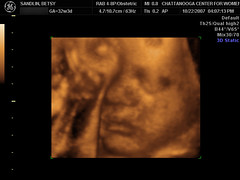
I am just blown away by the 3D ultrasounds that we had done yesterday. Not just because she’s my little girl (or soon will be) but the technology is insane. I watched it being done, and grok the how of it, but seeing it in action is difficult to wrap one’s head around. Tiny slices of imagery, layered and stitched to build a virtual 3D model, and then displayed and rotated for the best possible angle…
In any case, I’m trying not to go too much into babyland with this blog (that’s reserved for Brand New World) but I had to throw one of these up.
Just another amazing video from the maker of The Machine is Us/ing us. Digital information, as much as we like to treat it like paper, is just different.
The sooner librarians get their heads around this, the better for our patrons. I’m trying desperately to wrap my head around how this influences our new library building…
Here’s a great example of my very favorite misuse of quotation marks: the use of quotation marks to indicate emphasis, where it should probably be underlined or bolded. This is a card we recieved at our latest baby shower.
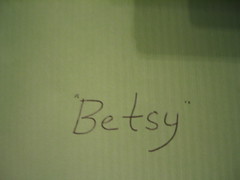
So it’s not for Betsy; it’s for someone like Betsy, or perhaps someone pretending to be Betsy?
Or maybe just Opera in general.
I own a Samsung Blackjack, and it probably comes as no surprise to anyone that Internet Explorer on it sucks. Just a horrible browser. Enter Opera Mobile, a really great little browser for mobile devices. I downloaded the trial version and gave it a month…good interface, fast, let me do everything I wanted.
So I decide I want to purchase this piece of software. It will make my life much easier, and is worth the $24.
I got to the Buy Opera page, tell them I want to buy a copy of Mobile for Smartphones, and it asks me for some info…including my “Device ID” which is evidently their method of DRM. By using a code specific to the phone, they can control whether or not I share the program by making it impossible for me to do so.
Ok, whatever. I can still move my install to another phone if I want by calling them, not perfect but I’ll deal. So how do I get the Device ID? By going to the “menu” function on the browser, on the phone.
Which doesn’t work, because the trial has expired, and all I get is an error message when I try to run it.
So…I can’t buy the software I want to use, because I tried the software to determine I wanted to use it.
Somehow, this seems appropriate again:
Thought before collapsing into bed:
Librarians have always been concerned with informational objects that have metadata associated with them that enhance findability…for example, a Book and it’s equivalent Catalog card or MARC record. We’ve layered metadata on top of our physical objects for years. We’re only now in the very recent past began scratching the surface of metadata for digital objects.
When we digitize a book, which is the “object” and which is an instantiation of that object? What is Primary? Where is the Real when you have a physical book and the digital copy both in existence? And what does the metadata describe then? I think Plato may have some answers, maybe.
Or maybe it’s way too late for me to be thinking about this.
Here’s my favorite tidbit from my writing fest this evening.
…links are the currency of the web. In network theory, Metcalfe’s Law says that the value of a system grows as approximately the square of the number of users of the system. That is, for any network, adding a node increases the value of that network. As well, adding a link to any piece of information on the web increases the value of that piece of information from the perspective of search engines, and increases its findability. Every bit of content that you re-purpose and link to becomes more valuable simply by the fact that you have chosen to do so.
Is that a law of the internet yet? “The value of any piece of information increases geometrically in relation to the number of links pointing at it…”
Not only is Radiohead releasing their newest album at whatever price their fans are willing to pay, and not only is the digital release completely DRM free and 160kbps MP3, but it looks like it was ripped to MP3 using LAME 3.93. An exploration of the MP3’s in a text editor reveals:

They need to upgrade…LAME is up to 3.97 now.
Looking at the header and footer of the files in both a text and hex editor doesn’t show any tracking numbers or codes tying the songs to a particular download. It really does look like these are regular old MP3s.
Thanks, Radiohead, for showing the recording industry how business should be done these days.